
Gleaston - Nr
Ulverston,
Cumbria - LA12 0QH
England
+44-(0)1229-869244
Gleaston Castle
Brief history | Additional Information | The Castle | Today
A Brief History
Gleaston Castle is a 14th Century ruin situated in a valley about 0.5km North-east of the village.
Gleaston Castle's history began in the mid 13th century when the le
Fleming family moved to the
valley from nearby Aldingham which had been their
seat of residence since 1066. Here they built
a manor house, probably
close to the centre of the existing castle yard. It is likely that it
consisted
of a wooden hall with an enclosure for cattle on the south side.
In 1297 John de Harrington I, Lord of Aldingham and Muchland and direct
descendant of Michael
le Fleming, began the construction of what is now the
South-west Tower and part of the west wall
ending with another tower.
Twenty-eight years later, in 1325, the building of the present day castle
was begun by either John
de Harrington I or his son John de Harrington II.
This building work was completed in c1340.
The castle was inhabited by the
de Harrington family for 118 years until, in 1457, William de
Harrington, last
Lord Harrington of Aldingham and Muchland, died without issue.
The castle
and estate passed to Lord William Bonvilla and eventually passed by marriage
to
Thomas Grey, great-grandfather of Lady Jane Grey, under whose ownership it
quickly decayed.
It is rumoured that Lady Jane Grey visited the castle
shortly before she became Queen of England.
Walter Curwen, bailiff to Thomas Grey's grandson, Henry Grey, leased and
later purchased the site
when either he or his successor, Thomas Preston,
appears to have made one of the Southern towers habitable.
The castle remained in the ownership of the Preston family until c1639
when it seems that a Richard
Gaitskell was living in the castle, possibly
occupying on of the South towers. He may have occupied
the site until the
1690's.
The ruin later passed to the Cavendish family, and was sold by Lord
Richard Cavendish of Holker
Hall to Thomas Barton Jackson, of Bolton Manor,
Urswick, a local farmer, on the 14th February
1920. It was bought by
William Simpson Webster Snr in 1926 and is currently owned by his son,
William
Simpson Webster Jnr and is still part of a working farm.
Additional Information and Interesting Facts
The Keswick Codlin
Mr Baker, the Fruit Officer to the Director of the Royal Horticultural
Society gardens at Wisley,
quoted that "Dr Robert Hogg's Fruit Manual for
1877, says that 'this excellent apple was first
discovered growing amongst a
heap of rubbish at Gleaston Castle (now a ruin) near Ulverston
and it was first
brought into notice by one John Sanders' - there is a John Sanders whose wife
propagated
it, sent it out under the name of Keswick Codlin in 1790'. Dr Hogg also
says that
'it is one of our finest culinary apples'
| The Castle |
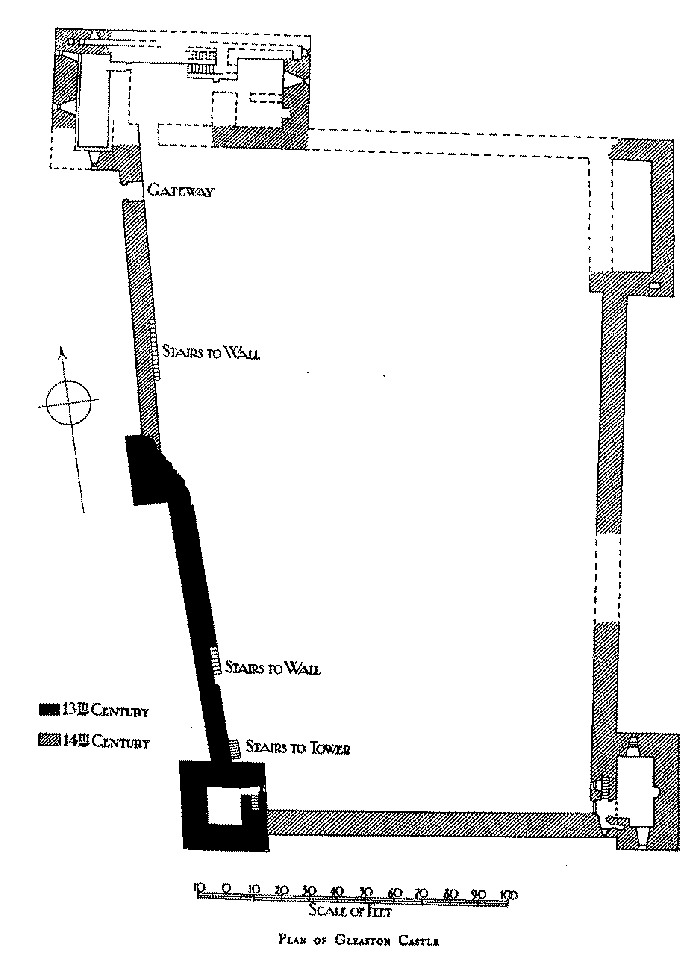 |
Click the castle plan to the left to see a full size view. Click 'Back' to return to this page |
In it's entirety the castle, built mainly of limestone with some red
sandstone features, consisted
of four corner towers with curtain walls
connecting each tower. It is likely that the interior of the
curtain walls
were lined with timber buildings such as barracks, stables and
workshops.
The North-western Tower is the largest and most important tower and was
used as the baronial residence.
It consisted of a Great Hall with dungeons
on either side and apartments above.
Near the North-western Tower, in the West wall, was a narrow arched
gateway. This was probably
used as a postern gateway as it is thought that
the main gateway was in the East wall.
The West wall, connecting the North-west Tower to the South-west Tower is
almost three metres
thick in places and up to nine metres high. Half way
along this wall is a mass of solid masonry,
thought to mark the initial extent
of the castle and is the remains of the original North-western
Tower.
The South-western Tower is the smallest in area, the highest, the oldest
and also the best
preserved of the four angle towers. It was used to house
officers and constables of the manor
and consists of a dungeon in the basement
with accommodation for the officers above. Above
this there are two more
floors and battlements reached by a spiral staircase.
The South-eastern Tower consisted of a two floor structure with
battlements above and a
basement below. A door on the first floor leads to
the only example of a wall-walk in the castle.
The function of this tower
is unknown but it was probably used as a dwelling as there are latrines
and two
large fireplaces.
Much of the East wall is hidden behind modern buildings. There may
have been a main gateway
in this wall but it is impossible to determine.
Little remains of the North-eastern Tower and so it is difficult to ascertain it's layout or structure.
The North wall was by far the weakest point of the castle and, because the
threat of Scottish raids
had passed by the time it was built, there was no need
for it to be as heavily fortified as the other
walls. It is even possible
that some of the later inhabitants of the castle made an ornamental
garden above
the North wall.
Today
At the present time the Castle is little more than a ruin. The
South-east and South-west Towers
are in the best condition but even these are
only a shell of four walls joined at the corners but they
still contain some
interesting features such as staircases, doorways, windows, fireplaces, latrines
and the corbels showing where the floors once were.
These give us a very
good idea of how it would have looked...with a little imagination!!!
There is very little remaining of the North-western Tower although this is
the most interesting.
It is possible to see parts of the Great Hall and
the ends of the long passage to the first floor are
distinct and impressive.
The castle is now in a delicate state with large cracks in many of the
tower walls. The stairs are
crumbling away and are difficult to
negotiate. Most of the mortar has dried out and is falling away
leaving
the large limestone blocks in a precarious position. The owners have
therefore been
advised not to allow people to enter and look around, in case of
accidents, but the ruins are
alongside the minor road between Gleaston and
Scales and most of the castle can be seen quite
clearly from the roadside,
especially if you walk up the hill and look back.
|
|
 |
 |
 |
 |
 |
 |
 |
 |
 |
 |
